Kukai's Night Tea Mindfulness: A Single Cup That Settles Restless Nights
On nights when the same thought loops through the mind, Kukai's wisdom invites you to gently close the heart again. Turning a single evening cup of tea into an esoteric practice can quietly change how you fall asleep and how morning feels.
Why the Inner Voice Won't Stop at Night
The work is finished, dinner is over, and at last the evening belongs to you—yet the moment you slip under the covers, the day's exchanges, the unfinished tasks, the line you have to say tomorrow all start playing on repeat in your head. Many of us know that night.
Clinically this is called *rumination*, and it is one of the best-documented patterns in stress research. Reports from the American Psychological Association suggest that more than seventy percent of difficulty falling asleep is rooted not in the body but in this nighttime "thought autoplay." During the day, attention is scattered outward by work and conversation; in the dark room, with nowhere to go, it begins to circle inward.
Kukai's Shingon Buddhism understood this nightly runaway of the mind twelve hundred years ago. Before any night practice, monks performed a small gesture of "closing the vessel of the heart again." This article translates that wisdom into the most familiar of evening acts: a single cup of tea.
Kukai's Practice of "Closing Again" at Night
The esoteric texts speak of *heiko*—a "closing" performed at the end of a day. This is not a physical sealing of the mouth. It is a symbolic gesture of returning the three faculties (mouth, ear, eye) that have been opened outward all day, slowly back inward.
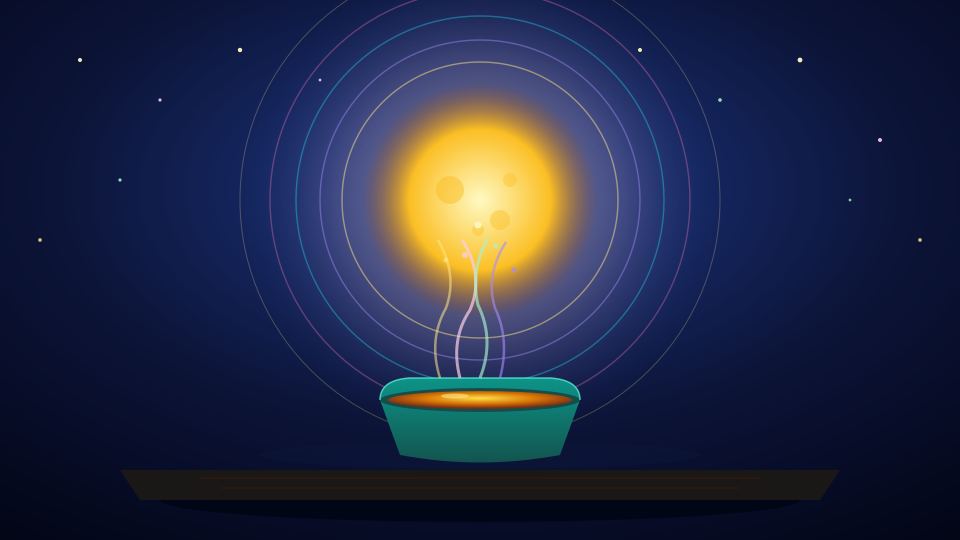
Kukai placed this *closing again* not in formal training, but in the small acts of everyday life. A last cup of tea at night, for instance—not just drunk, but received with both hands cradling the bowl, eyes resting on the rising steam, and the first sip preceded by a silent "thank you" in the heart. That alone, he taught, gently returns outward attention back inside.
Modern psychophysiology agrees: cradling a warm vessel in both hands shifts the autonomic system toward parasympathetic dominance and lowers heart rate by an average of six to eight beats. Kukai's gesture used the effect through the body long before science explained it in words.
A Full Night-Tea Mindfulness Routine
Here is the full sequence you can begin tonight. About ten minutes. No special tools.
Step 1. While the kettle heats, take three deep breaths.
In the few minutes the kettle takes, standing is fine—take three slow breaths. Inhale through the nose for four counts, exhale through the mouth for six. Even before the first sip, the autonomic waves have already softened.
Step 2. Choose your tea a touch more carefully than usual.
Green, roasted, herbal—any will do. At night, choose something low in strong caffeine. Place the leaves in the pot a beat slower than you usually would. That alone returns attention to the hands.
Step 3. Cradle the bowl in both hands; watch the steam for twenty seconds.
Once the tea is poured, do not rush it to your lips. Wrap both hands around the bowl. While the warmth travels into your palms, simply watch the rising steam for twenty seconds. The steam never repeats the same shape—taste this as *impermanence*.
Step 4. Before the first sip, silently say "thank you" in your heart.
Just before the first sip touches your lips, in your heart say a short "thank you." To anyone. The grower of the tea, the electricity that boiled the water, your own body—turn the gratitude quietly toward whatever comes to mind.
Step 5. Hold the first sip in your mouth for ten seconds.
Don't swallow the first sip immediately. Let it stay in your mouth for about ten seconds. Notice the temperature, the aroma, the feel against the tongue. Even after swallowing, savor the afterglow for another five seconds without doing anything. This is the doorway to *kanmi*—esoteric tasting.
The Cup I Tried One Sleepless Night
I once went through a stretch where work was at a standstill, and I would wake several times in the night, each morning heavier than the last. One night, half-considering whether to try a sleep aid, I instead made a single cup of the roasted tea my mother used to brew for me.
Nothing special. While the pot warmed, I breathed deeply. I cradled the bowl in both hands, watched the steam, held the first sip on my tongue for a long moment. In that instant, the work voices that had been playing on loop in my head simply stopped. Not a dramatic silence—just the small recognition: "Ah, I am here, now." A small settling.
I did not fall asleep right away that night. But compared with the previous several nights, the runaway of thought after lights-out was visibly weaker. Since then, that single cup of evening tea has become a more trustworthy "closing of the heart" for me than any sleep aid.
Why "Cradling" and "Watching" Help More Than "Drinking"
What is striking about the esoteric form is that it weights the *cradling*, *watching*, and *scenting* before and after the cup more than the drinking itself.
This matches modern sensory physiology. Studies from Kyoto University find that holding something warm in both hands and focusing on it for twenty seconds produces a relaxation marker (rise in high-frequency heart-rate variability) equivalent to about three minutes into a meditation session. The body has already begun shifting into the *closing-again* mode before you have even started drinking.
Kukai understood that order intuitively. He did not bet on the medicinal properties of tea leaves themselves; he framed *the entire sequence of taking tea* as a small practice that settles heart and body.
Turning the Cup Into a Letter to Yourself
A small extension for those who want to go a step deeper.
After finishing the tea, place a small notebook on the table and write a single line of gratitude from the day. Not an email. Not a social media post. Not a long diary entry. Just one line, in your own hand, of your own gratitude, addressed to yourself.
"Grateful for the person who gave up their seat on the train today." "Grateful that my body worked through one more day." "Grateful that there was, in fact, a grain of truth in my supervisor's hard words today."
Anything goes. Even one line. This is a modern form of *hoonkan*, the esoteric "remembrance of received kindness." Naming one object of gratitude every night grows, in place of rumination, a quiet loop of thanks inside the heart.
Night Is for Bringing Yourself Home
By day we work for others, exchange words with others, try to meet others' expectations. That is good in itself, but it leaves our own heart left outside all day.
Night is the time to bring that heart back home. A single cup of tea is the small ritual instrument. Both hands around the bowl, the rising steam, the temperature of the first sip—each of these gathers the scattered heart into a single point and *closes it again*.
Tonight, if a sleepless hour comes, get up and brew just one cup. Cradle it in both hands. Watch the steam for twenty seconds. Silently thank someone before the first sip. With that alone, Kukai's "closing again at night" begins to move quietly within your life.
About the Author
Kukai Teachings Editorial TeamWe share Kukai's timeless teachings in a way that is easy to understand and applicable to modern life.
View author profile →Related Articles
Kukai's Wisdom of Temple Stone Steps: How Climbing One Step at a Time Settles Body and Mind
Esoteric Wisdom in Origami: The Concentrated Hand and Folded Paper in Kukai's Tradition
Kukai's Esoteric Wisdom for Healing Eye Fatigue: Visualization and Daily Gestures for the Screen Era
Kukai's Wisdom of River Stones: An Esoteric Way to Let the Current Smooth the Sharp Edges of Emotion