Kukai's Wisdom of Temple Stone Steps: How Climbing One Step at a Time Settles Body and Mind
The stone stairs at Koyasan or the Shikoku temples are not just routes to a hall—they are themselves esoteric practice devices. This article weaves the rhythm of step and breath with modern exercise science into a wisdom you can practice at any neighborhood temple.
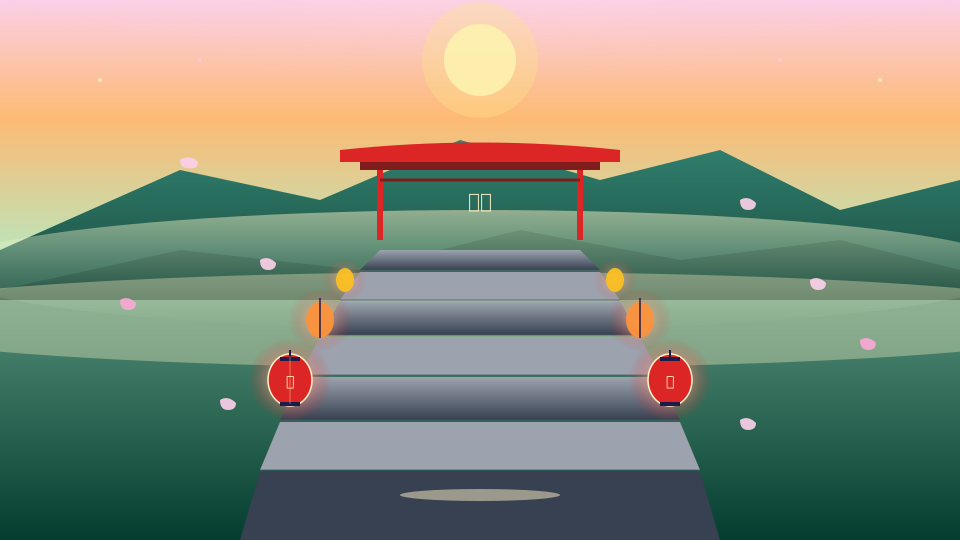
Why Old Temples Have So Many Stone Steps
Okunoin at Koyasan, the mountain temples of the Shikoku 88, the long approaches of old Kyoto temples—the older the temple, the longer the stone stairs to the main hall, often with rises that vary unevenly from step to step. Tourists sometimes wonder, "Why not build an easier path?" Why has this stretch of stone been preserved unchanged for over a thousand years?
The answer is simple: the stairs themselves are practice devices. In Kukai's Shingon Buddhism, the way leading up to the main hall has long been treated as the time to settle body and mind. Not a fitness test, not a barrier to keep visitors away. Each step quietly puts something in the heart back in order. The approach was designed for that.
Modern exercise science agrees: stair climbing is among the most efficient aerobic exercises, and fifteen minutes of continuous climbing produces a metabolic load comparable to about forty minutes of walking. Rhythmic leg motion also raises serotonin and reliably lowers anxiety. The stone stairs of Kukai's age, in a sense, embedded these findings into daily landscape twelve hundred years early.
This article uses the temple stairs as a doorway and offers a practical "esoteric stair-climbing" routine you can apply to any neighborhood temple's flight of steps.
Kukai's Love of "Ascending Practice"
Kukai loved mountain practice his whole life. As a young man he wandered the mountains of Yoshino in Nara; later, he chose Koyasan—a plateau eight hundred meters up—as the central monastery of esoteric Buddhism. Why pick a place you can only reach by climbing, rather than the plain?
It connects to his view of the body. Esoteric Buddhism takes the body as the entry point through which the mind is set right. Climbing is a sequence in which one is aware of one's own weight, presses each foot into the ground for confirmation, and rises slowly toward a higher place. Inside that sequence, the breath naturally deepens, posture aligns, and the mind grows quiet—territory that sitting meditation alone does not reach.
Stone stairs, especially, have a distinct effect that flat slopes do not. Step by step the body must judge "up or down, place or skip," and that string of small judgments leaves stray thoughts no place to settle. You will fall if you walk while looking at a phone; that simple fact reveals the heart of stairs as a practice device.
"One Breath, One Step"
Here is a concrete routine. It works at any neighborhood temple, shrine, or scenic stairway, and you can begin today.
Setup: pause just before the first step.
Do not begin climbing immediately. Pause for a beat just before the first step. This is the gesture of setting a boundary. Inwardly draw a line: "Beyond here is the approach." Place the gaze two or three steps ahead.
Step 1. One step per breath.
Climbing the first step, slowly inhale while the leading foot rises, then exhale while weight transfers onto it. One step, one breath. At first, the foot may feel "ahead of the breath." That is fine—deliberately slow the breath until it leads.
Step 2. Keep the gaze two or three steps ahead.
Looking only at the feet stiffens neck and shoulders; looking too far up unbalances you. Two or three steps ahead is the practical zone. That distance corresponds to what esoteric Buddhism calls *chūdō*—the wisdom of the middle, avoiding extremes.
Step 3. Insert "the courage to pause" every five steps.
On a long stair, pause for half a step every five steps and let the breath even out, even if it feels fine. This is practice for one of the gestures modern life is worst at—the courage to stop briefly.
Step 4. At the halfway turn, look back.
At a landing or roughly halfway up, turn around once and look back at the steps already climbed. Count them with the eyes. This is the esoteric practice of *acknowledging your own progress*, a small gesture that becomes a foundation for self-trust.
Step 5. On the very last step, bring both feet together.
For the final step before the main hall, do not lead with one foot; bring both feet together. This is the old gesture of "approaching with feet aligned"—a first bow toward the buddha you are about to face with joined palms.
What I Noticed on Wet Stairs After the Rain
I had a memorable experience on temple stairs once. On a small trip out of the city, I happened to stop at a mountain temple just after a rain shower had cleared. There were almost no other visitors, the moss-covered stairs were wet, and the footing was slipperier than I expected.
At first I felt mildly impatient and just wanted to be done with the climb. Then around the fifth step, my foot nearly slipped, and from that point on I naturally began checking how each foot landed. To my quiet surprise, the work worries that had been spinning in my head retreated, almost without my noticing. By the time I reached the main hall, several problems that had felt heavy ten minutes earlier had taken on a margin: "Well—I can think about that again tomorrow." It was as if the stairs had organized my head on my behalf.
That night, no profound revelation came. But I do remember sleeping just a little more soundly than usual.
Find One "Local Stair" of Your Own
Few of us can travel monthly to Koyasan or the Shikoku pilgrimage circuit. But esoteric wisdom is not reserved for famous sacred sites.
Find one "stair" of your own within fifteen minutes of home—on foot or by train. A temple, a shrine, a long flight in a riverside park, even the long stairway from a station platform up to the street. By Kukai's *sokuji nishin*—truth in the immediate—everyday stairs all serve as substitutes for temple steps.
Once a week, climb your stair using the "one breath, one step" routine. Ten to twenty minutes does it. That alone secures, once a week, a session in which body and mind reliably reset.
Descending Has Its Own Form
One last point, easy to overlook but important: stairs are not only for climbing. Descending has its own form.
Going down feels faster than going up, and is harder on the knees. Medically, more than seventy percent of stair-fall accidents occur on the descent. The descending stair is also a metaphor for "the stage after success or achievement" in life.
The form for descending: shorten the stride slightly, place the gaze three steps below, land on the ball of the foot, and lower the heel slowly. That alone halves the impact on the knees. And insert the "courage to pause" every five steps even more strictly than on the way up. *Slower on the way down* is the esoteric form of stairs.
A Layer of Steps Changes the Self in a Year
If we take only one thing from the wisdom of temple stairs, it is this obvious-but-easily-forgotten truth: a layer of single steps will reliably carry you to a higher place.
In daily life, we grow disappointed at the smallness of the next step in front of us, anxious at the distance of a peak we cannot yet see, and we often stop walking altogether. Stairs do not allow that. The summit is reachable only one step at a time.
Kukai's choice of Koyasan—a place high up—was, I believe, his way of asking each of us, walking the long stair of a life, to remember that obvious truth through the soles of the feet and the breath.
This coming weekend, please visit one stair near you. Climb it slowly, one breath at a time. By the time you bring your palms together at the main hall or the torii, you will not be the same person who started. That is the first sign that Kukai's wisdom of stone steps has begun to move within you.
About the Author
Kukai Teachings Editorial TeamWe share Kukai's timeless teachings in a way that is easy to understand and applicable to modern life.
View author profile →Related Articles
Esoteric Wisdom in Origami: The Concentrated Hand and Folded Paper in Kukai's Tradition
Kukai's Esoteric Wisdom for Healing Eye Fatigue: Visualization and Daily Gestures for the Screen Era
Kukai's Wisdom of River Stones: An Esoteric Way to Let the Current Smooth the Sharp Edges of Emotion
Esoteric Buddhism's 'One Incense Stick' Practice: How a Burning Stick Teaches the Art of Deep Focus